- Quantum networking
- Error correction
- Funding and policy
- Calls and events
One quantum link per millisecond, thirty logical qubits with an asterisk, and a $215 million bar
A 1.03 kHz ion–diamond link at 87.9% fidelity, Infleqtion’s 30 logical qubits read closely, and the DOE’s 100-logical-qubit competition that closes 19 October.
By OmLabs9 min readUpdated 11 Oct 2026, 22:50 IST
At a glance#
- A faster quantum link, with a trade-off. A 39-author team reports entangling a trapped barium ion with a diamond memory at 1.03 kHz and 87.9% fidelity, about four times the previous trapped-ion photonic-link rate (preprint, IonQ release).
- A “30 logical qubits” headline that needs reading closely. Infleqtion’s result uses a distance-2 code; what the code can detect and what it can correct is the whole story (Quantum Computing Report, independent analysis).
- The bar has a number now. The US Department of Energy’s Q Competition asks for machines with at least 100 logical qubits and closes applications on 19 October (DOE).
- Money and policy are lining up behind fault tolerance in the EU, Germany and NATO, while India’s most visible near-term hardware milestone is still unconfirmed.
This is the first edition, so it covers the last two weeks rather than one day.
A quantum link that keeps pace with the processor#
No single vacuum chamber or cryostat will hold a useful fault-tolerant machine. The working plan, across trapped ions, neutral atoms and superconducting devices alike, is to build modules and link them with photons. The catch is rate: photons are lost on the way, most attempts fail, and so links have been slow compared with the gates they are meant to serve.
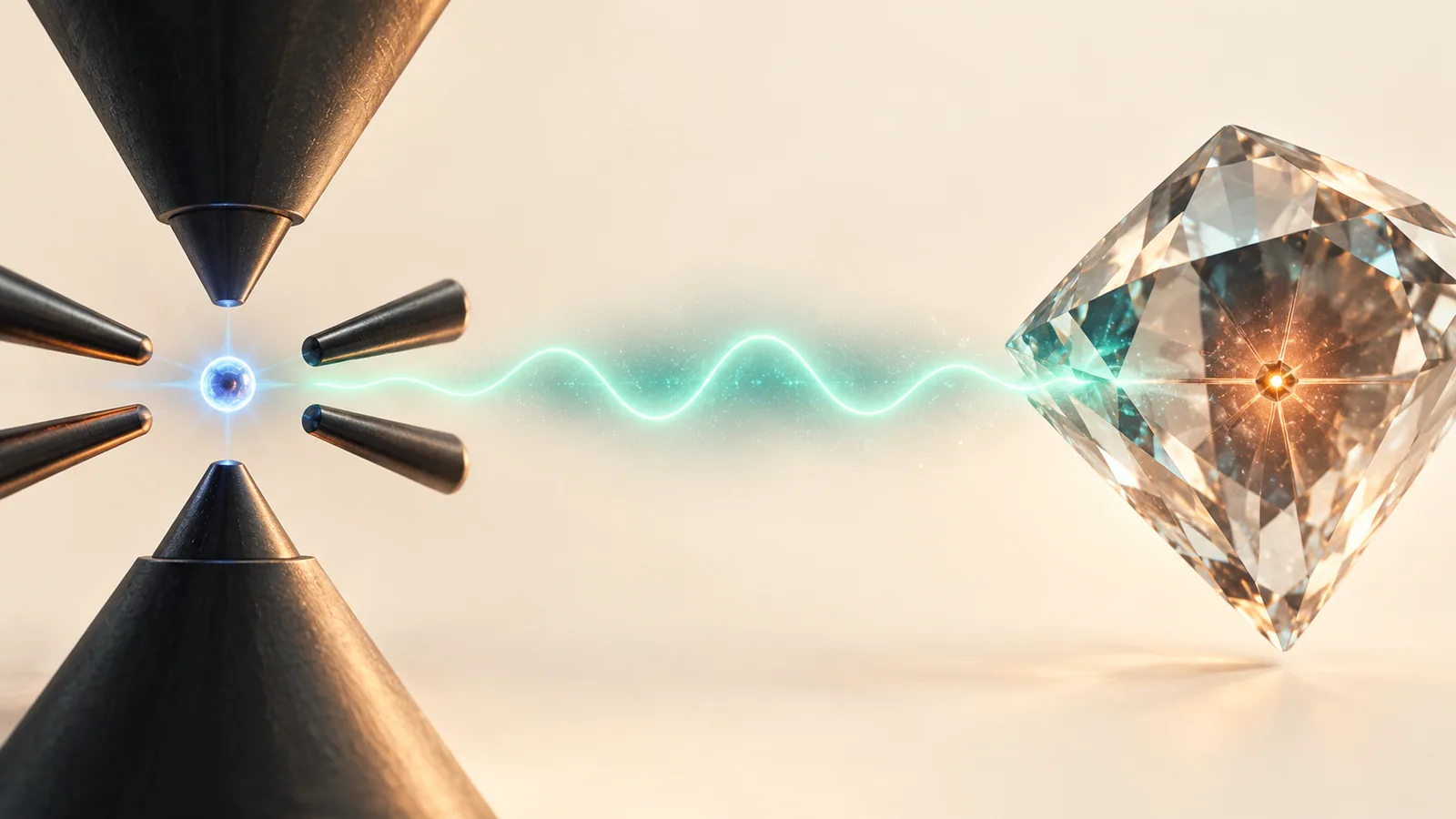
On 9 October IonQ announced a link that narrows that gap. The technical work is a preprint, arXiv:2610.10705, submitted on 7 October by Lukas Hartung and 38 co-authors, among them Christopher Monroe. The team entangles a single trapped barium-138 ion with a silicon-vacancy (SiV⁻) colour centre in a diamond nanophotonic cavity. A photon emitted by the ion has its wavelength and encoding converted, is reflected from the SiV⁻–cavity system and is detected; seeing that one photon heralds that the two are entangled. Counting all conversion losses, the authors report Bell pairs at an average of 1.03 kHz, roughly one per millisecond, at 87.9(7)% fidelity.
IonQ describes the silicon-vacancy centre as a solid-state quantum memory, which is what the “memory-enhanced interconnect” label in its release refers to. The authors frame the result as matching the cycle time of planned trapped-ion processors, which is the point of the title: quantum networking at the speed of quantum computation.
How it compares#
The authors say the rate is four times that of the fastest photonic link between two trapped ions. IonQ’s release credits that record to Chris Monroe’s group at Duke, published in Physical Review Letters in 2024: about 250 entanglement events per second with a Bell-state fidelity above 94% (a lower bound), between two barium ions. The arithmetic checks out: 1,030 divided by 250 is about 4.1.
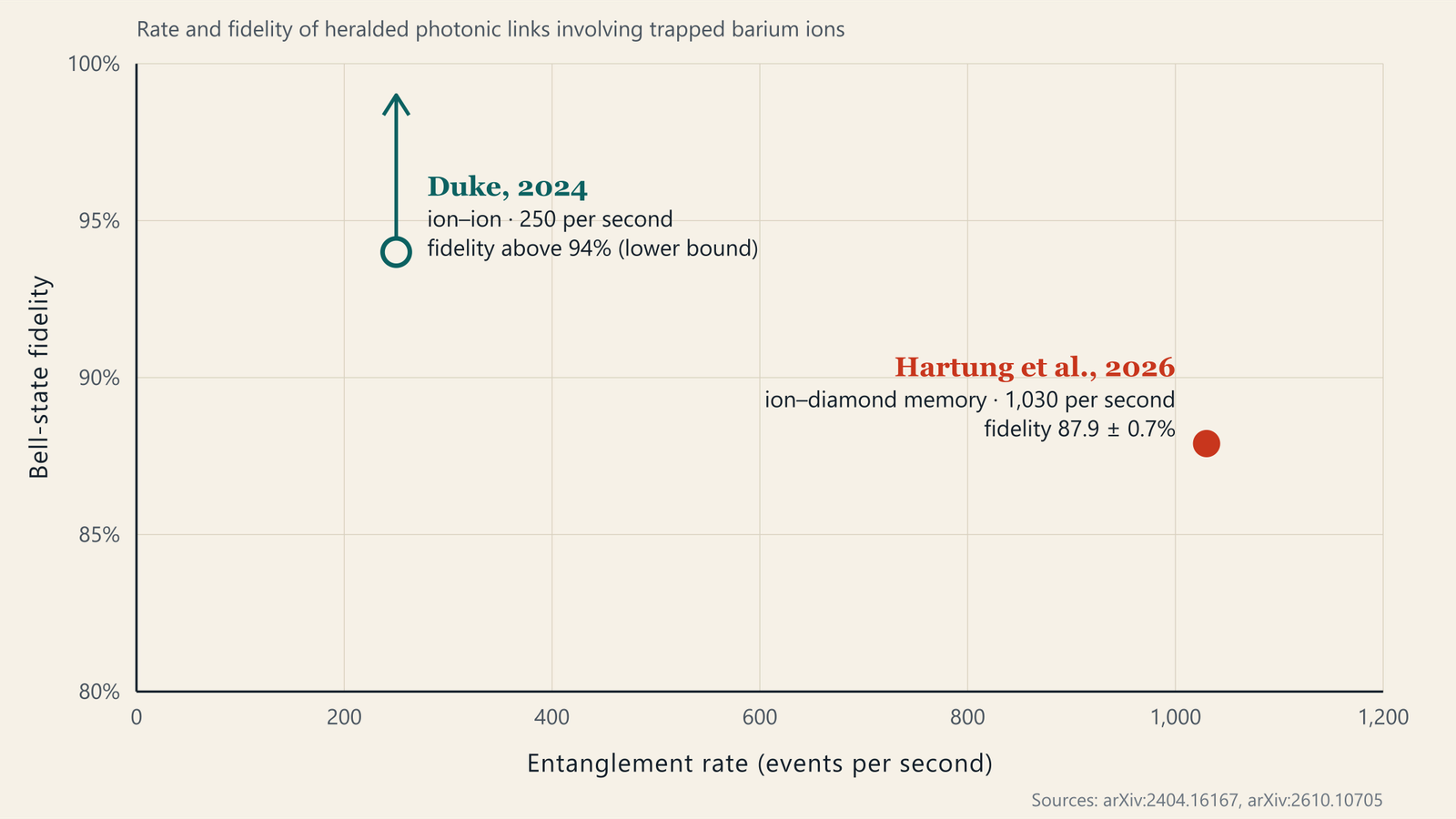
Read the chart before the headline. The new link buys speed with fidelity: 87.9% is lower than the earlier link’s lower bound. The comparison is also not strictly like for like, because one link joins two ions and the other joins an ion to a solid-state memory. As general background (not a claim from either paper), raw entangled pairs at this fidelity are normally treated as a starting resource that purification protocols can improve, at a cost in rate. Whether a net gain survives that step is the question to watch.
Three further cautions. First, this is a preprint, not a peer-reviewed paper. Second, “world-first” and “fastest quantum interconnect rate between qubits of any platform” are IonQ’s own descriptions, and the press release gives no fidelity at all; the number is in the paper. Third, it is a link-level milestone, not a distributed quantum computer. IonQ says the architecture is expected to be compatible with neutral atoms and superconducting systems; that is an expectation, not a demonstration.
Thirty logical qubits, with an asterisk#
On 24 September Infleqtion said it had entangled 30 logical qubits encoded in 80 atoms on its Sqale neutral-atom machine, announced at Quantum World Congress with the experiments run in August. The atoms form ten blocks of eight, each block encoding three logical qubits. The workload was an IQP-style sampling circuit with about 1,000 physical operations and four logical CCZ gates, plus software that reconstructs measurement outcomes lost with an atom (Quantum Computing Report).
The detail that changes how to read it comes from an independent analysis. It reports that the blocks are prepared in a distance-3 code and operated in a distance-2 code. A distance-2 code guarantees that a single physical error is flagged, not that it can be corrected. In that reading, runs where an error is flagged are discarded, and about 25% of the measured outputs landed in the set the ideal circuit produces, which the company describes as roughly 1,000 times stronger than the noise level. The analysis points out what is not published: a logical error rate, the fraction of runs kept, and a comparison against unencoded atoms. It also notes that discarding runs does not scale, because the kept fraction falls with every added operation, and that the company’s own 2026 target originally said “error correction”.
Treat that as one critical reading of company data, not a verdict. Infleqtion’s result is real engineering: 80 atoms controlled coherently, loss handled in software, and a gate construction that halves the two-qubit gate cost per logical entangling operation, from eight to four. The point is narrower. “Logical qubit” has become a unit whose meaning depends on the fine print.
Five questions for any logical-qubit headline#
Editorial checklist from OmLabs Radar; this table is analysis, not drawn from the sources.
| Question | Why it matters |
|---|---|
| What is the code distance? | Distance 2 detects one error; distance 3 is the smallest that can correct one. |
| Does the result correct errors or only detect and discard them? | Discarding runs (“post-selection”) does not scale to long computations. |
| What fraction of runs was kept? | A small kept fraction can hide a large raw error rate. |
| What is the logical error rate, and is it below the physical one? | Encoding only helps if logical beats physical. |
| Is there a like-for-like unencoded baseline? | Without it, the benefit of the code is an assertion. |
The bar: 100 logical qubits, and who is paying#
Why the definition matters now is that money has attached itself to it.
United States. On 17 September the DOE opened the Quantum Genesis Q Competition: up to $215 million in planned funding (only $2.5 million of it in fiscal-year 2026 dollars, the rest subject to appropriations), seeking proposals to deploy computers with at least 100 logical qubits. Phase I awards are fixed at up to $1.5 million each; Phase II adds a $100 million pool for a first-generation machine at 100 logical qubits and two $50 million bonus pools at 150 and 200. Applications are due 19 October and are open to private-sector companies. A separate $45 million call covers a national-laboratory testbed. The announcement page does not define “logical qubit”; the request for applications will, and that definition is the thing to read.
On 8 October the Office of Science released eight priority applications across four domains (chemistry, materials, subatomic physics and applied mathematics), each with example target computations, to ground what “scientifically relevant” should mean for these machines. DOE’s Quantum Genesis page states the aim as systems with “logical qubits numbering in the low hundreds in 2028”.
Germany. QUDORA leads a seven-partner consortium, including the PTB, Forschungszentrum Jülich, NXP Germany and AQT, targeting a trapped-ion machine with at least 1,000 physical and 50 logical qubits and a logical gate error below 0.01%, verified with a quantum Fourier transform (AQT). The project is worth about €122 million under a federal competition, but read the status carefully: the outline phase is complete and the consortium may now submit its full application. Approval and funding are still ahead.
European Union. EuroHPC’s six new quantum calls total about €119 million (the sum of the six budgets) and all close on 17 November 2026 at 17:00 CET:
| Call | Topic | Budget | Requirement stated |
|---|---|---|---|
| TIPT-09 | Trapped-ion platforms | €20M | Over 1,000 individually addressable physical qubits |
| SPT-10 | Superconducting platforms | €20M | At least 1,000 physical qubits |
| NAPT-11 | Neutral-atom platforms | €20M | 1,000 physical qubits for computing; 10,000 atoms for simulation |
| NQKD-12 | Next-generation QKD | €24M | None stated |
| QTI-13 | Quantum-testing infrastructure | €20M | None stated |
| QEXP-14 | Experimental pilot lines | €15M | None stated |
Networks, alliances and one retreat#
The Quantum Internet Alliance entered its next phase with €47.5 million from the European Commission for 42 months. The stated milestone connects directly to this week’s link result: showing that two metropolitan-scale quantum networks can be interconnected over a long-distance fibre link using quantum repeaters, within a complete, programmable network prototype.
NATO published a public summary of its quantum technology roadmap, approved by Allies on 30 July. It covers computing, communication and sensing and their interaction with AI, space and communications networks. The public summary sets no timelines or numerical targets. Belgium and Bulgaria joined the Transatlantic Quantum Community.
Pasqal said on 28 September that it is leaving France’s LSQUARE (PROQCIMA) defence programme after completing the first phase’s technological objectives, to focus on commercial applications. French public bodies (the SGPI and DGE) have asked it to submit a neutral-atom fault-tolerant computing R&D programme for civil support. No funding or timeline was given.
Research note: fewer gates is not fault tolerance#
Oak Ridge National Laboratory highlighted on 29 September an algorithm called LuGo, a modified quantum phase estimation routine that moves work into classical pre-processing. For a fluid-flow (Hele-Shaw) problem solved with the HHL algorithm, the team cut the gate count from about 2 million to 91,000. The work is published in Future Generation Computer Systems 178, 108270 (2026).
Two limits keep this in proportion. Gate count is a proxy for noise, not a measured error rate, and the article reports no accuracy or runtime figures. And it concerns one problem; the classical pre-processing cost is not quantified. Fewer gates is useful, but it is not a fault-tolerant resource estimate.
For readers in India: a watch item#
In July, Quantum Computing Report reported that IBM, the Andhra Pradesh government and TCS were working toward an IBM Quantum System Two with a 156-qubit Heron processor at the Quantum Valley Tech Park in Amaravati, with full operational commissioning targeted for September 2026, subject to export licensing and definitive technical agreements. As of this edition, I could not find a public confirmation that commissioning has happened, or that it has slipped. We will report it when there is a primary source.
Calls and deadlines#
- 19 October 2026: DOE Quantum Genesis Q Competition applications (private-sector companies).
- 17 November 2026, 17:00 CET: all six EuroHPC quantum calls.
Why it matters#
The common thread this fortnight is that quantum computing is being asked to count more carefully. A link is judged on rate and fidelity. A logical qubit is judged on distance, detection versus correction, and what was discarded. A funding call is judged on how it defines the unit it pays for. For a researcher or engineer, the practical habit is the same in each case: find the number the press release leaves out, usually in the paper, and ask whether it changes the conclusion.
Notes & sources
- s01IonQ demonstrates world-first quantum memory-enhanced interconnect for distributed quantum applications
IonQ (press release) · 9 Oct 2026
- s03Fast photon-mediated entanglement of continuously cooled trapped ions for quantum networking (arXiv:2404.16167; Phys. Rev. Lett. 133, 090802)
arXiv / Physical Review Letters · August 2024
- s04Infleqtion achieves 30 entangled logical qubits on Sqale neutral-atom quantum processor
Quantum Computing Report · 24 Sept 2026
- s05Infleqtion’s 30 logical qubits rely on error detection
PostQuantum.com (independent analysis) · Date not stated
- s06DOE launches competition to accelerate development of world’s first fault-tolerant quantum computer (Q Competition)
U.S. Department of Energy · 17 Sept 2026
- s07DOE announces science applications for quantum computing
U.S. DOE Office of Science (via Newswise) · 8 Oct 2026
- s08Quantum Genesis
U.S. Department of Energy · Date not stated
- s09AQT joins €122M NFQC-1k project
AQT · 29 Sept 2026
- s10Six new quantum calls launched by EuroHPC Joint Undertaking
EuroHPC Joint Undertaking · 14 Aug 2026
- s11QIA enters phase to build full-stack quantum networks
Quantum Internet Alliance · 30 Sept 2026
- s12NATO releases quantum technology roadmap
NATO · 29 Sept 2026
- s13Pasqal announces an evolution of its collaboration framework with the French public authorities
Pasqal (press release) · 28 Sept 2026
- s14Breaking a quantum computing bottleneck (LuGo; Future Generation Computer Systems 178, 108270)
Oak Ridge Leadership Computing Facility · 29 Sept 2026
- s15IBM to commission one of India’s first physical quantum computers in Amaravati by September 2026
Quantum Computing Report · 3 Jul 2026